"Canva Isn't Real Design" and Other Things People Say When They're in the Middle of the Bell Curve
Someone on LinkedIn said Canva isn't real graphic design. After 20 years of using design tools, I have thoughts. Here's what the skill bell curve teaches us about tool snobbery, knowledge bases, and AI.


Someone on LinkedIn once wrote that "Canva isn't real graphic design."
It stuck with me. Not because I was offended (I use Canva all the time including for this post image), but because it was such a perfectly distilled example of a very specific kind of snobbery. The kind where someone mistakes the complexity of their tools for the quality of their output.
Here's the thing: I've been using graphics tools for over 20 years.
Photoshop, Sketch, Figma, and a boatload of others I've already forgotten the names of. I've done the rounds. And after all that, I settled on the tool that apparently "isn't real graphic design software" because it's easier. Because it lets me do what I need to do without fighting the interface to get there.
That's not a beginner's choice. That's a full-circle choice. And honestly, it tells you a lot more about where that LinkedIn commenter sits on the skill spectrum than they probably realize.

Become an expert in all things Knowledge Base with our monthly newsletter. No spam, just expert content, delivered.
The bell curve nobody wants to be in the middle of
You've probably seen the meme. Three figures on a bell curve: a beginner on the left, a huge crowd in the middle, and an expert on the right. The beginner says something simple. The expert says the same simple thing. And the entire middle section is busy overcomplicating everything.
It's funny because it's painfully accurate.
"The people in the middle? They're the ones writing LinkedIn posts about how Canva isn't real design."
The beginner uses Canva because it's there, it works, and they need a social media graphic by 3pm. The actual expert (someone who's been designing professionally for 15 years) also uses Canva, because they understand that the tool doesn't make the designer. They'll jump between Figma, Illustrator, Canva, and a napkin sketch depending on what the job needs.
The people in the middle? They're the ones writing LinkedIn posts about how Canva isn't real design.
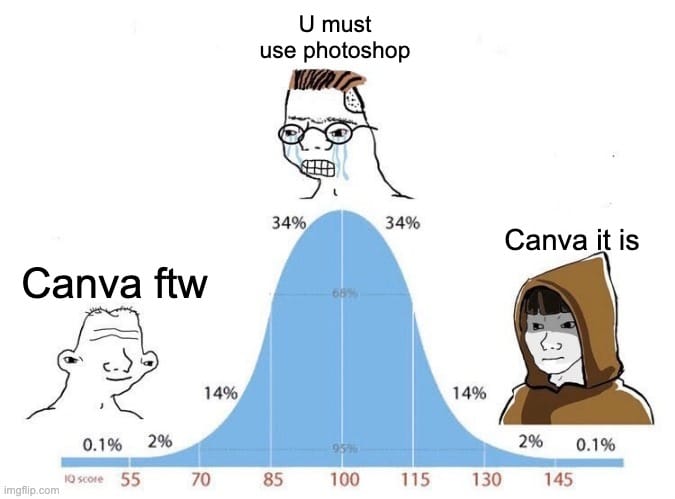
They've learned just enough to have strong opinions about software, but not enough to realize that gatekeeping tools is the opposite of expertise. Real expertise is knowing when the "basic" tool is the right one.
This isn't just about design tools
This pattern shows up everywhere. And if you work in customer support, knowledge management, or really any operational role, you've seen it firsthand.
"A simple FAQ page isn't a real knowledge base."
"If you're not using [expensive enterprise platform], you're not serious about documentation."
"AI-generated answers aren't real support."
Sound familiar?
It's the same energy. Someone in the middle of the skill curve confusing tool complexity with outcome quality. They've moved past the beginner phase where they just needed something that worked, and now they're deep in the weeds of specialized workflows and opinionated setups.
Which is fine (that's a normal part of learning). The problem is when they get stuck there and start assuming everyone else should be too.
The self-proclaimed expert trap
Here's where it gets a bit uncomfortable.
The people most likely to gatekeep tools are the ones who've built their identity around using specific ones. Their expertise isn't really expertise. It's familiarity.
"They've spent hundreds of hours in one particular ecosystem and now they feel threatened by something that lets a newcomer get 80% of the same result in 10% of the time."
They know the keyboard shortcuts. They've memorized the menu structures. They've spent hundreds of hours in one particular ecosystem and now they feel threatened by something that lets a newcomer get 80% of the same result in 10% of the time.
That's not expertise. That's sunk cost fallacy wearing a lanyard.
Actual experts tend to be tool-agnostic. They care about outcomes. They'll use whatever gets the job done efficiently, because they understand the principles underneath the interface.
A great designer understands composition, hierarchy, and color theory whether they're in Photoshop or Canva. A great support lead builds clear, findable documentation whether they're using a wiki, a knowledge base, or a well-organized Google Doc.
The tool is a vehicle. The skill is knowing where to drive.
What this means for how you build your knowledge base
Let's bring this home, because this bell curve problem causes real damage in knowledge management.
A lot of that wasted time comes from the middle-of-the-bell-curve mindset: overengineered systems, overly complex taxonomies, tools chosen for their sophistication rather than their usability.
The beginner approach? Throw answers in a shared doc and hope people find them. It's messy, but it works for a team of three.
The middle-of-the-curve approach? Build an elaborate internal wiki with nested categories, custom metadata, approval workflows, and a 40-page style guide for documentation. Nobody updates it. Nobody can find anything. But it looks very impressive in a quarterly review deck.
The expert approach? Use a knowledge base tool that's simple enough that people actually write in it and organized enough that people actually find things. Prioritize clarity over complexity. Accept that a good-enough article published today beats a perfect article stuck in a review queue for six weeks.
The sweet spot is a knowledge base that's genuinely easy to use, for the people writing it and the people reading it.
AI is the new Canva, and the discourse is already exhausting
Right on schedule, the same bell curve dynamic is playing out with AI in customer support.
Beginners are trying AI tools because they seem helpful. Experts are integrating AI because they understand it's a force multiplier that handles repetitive queries so humans can focus on complex ones.
And the middle? The middle is writing think pieces about how "AI isn't real support." AI can't fix bad documentation. But it can make good documentation dramatically more effective.
That's the expert take. Not "AI good" or "AI bad," but "AI is a tool, and like every tool, it works when the fundamentals are solid."
Stop letting the middle of the bell curve make your decisions
If there's one takeaway here, it's this: be suspicious of anyone who tells you a tool isn't "real" enough.
Real enough for what? If it solves the problem, it's real. If your customers can find answers, your knowledge base is working. If your team can publish documentation without a three-week review cycle, your process is working. If Canva helps you ship a decent-looking header image in 10 minutes instead of 3 hours, that's not cheating. That's efficiency.
The best tools aren't the most complex ones. They're the ones people actually use.
And if someone on LinkedIn tells you otherwise, just remember where they probably sit on the bell curve 😆