Your support queue feels angrier. The data disagrees.
Customer rage hit record highs in 2025, but incivility didn't. The research on what actually changed since 2023, and why your support queue went quiet.

I'm an avid LinkedIn user. Not because I like to post inspirational stories, but because I like to get the industry gossip 🥲
A popular scheduling tool ran a webinar recently to walk people through new branding, new features and a pricing change. The chat turned nasty fast.
Not disappointed, not skeptical. Personal. The kind of thing you read on your phone at night...on Reddit.
Anyone who has shipped software in the last couple of years recognizes that scene.
The feeling behind it is that users want more, pay less, and complain harder than they used to, and that something flipped around the time general AI showed up. If you work in support, you feel it as a queue that got heavier and meaner. It feels true, and it feels like it started in 2023.
So I went looking for evidence. Is this really the case, or are we all just a bit less optimistic? 🤔
Some of it backs the feeling up. A chunk of it points somewhere more interesting, and more useful if you are the one shipping.
The rage is real and it's measurable
There's a long-running study for exactly this.
The National Customer Rage Survey has been running since 2003. The 2025 edition polled 1,000 US people online.
77% percent said they had a problem with a product or service in the past year. Of those, 64% reported feeling rage about it. Half raised their voice to express displeasure, which is a record high for the study. 7 percent admitted to actively seeking revenge on a company, which tripled since 2020.
But people are slightly less rude than they were in 2023
Here is the part that stopped us. Because what??
The same survey asked people whether they had personally behaved uncivilly toward a business in the past year. Fifteen percent said yes. In 2023, that figure was 17%. It went down.
Meanwhile 55% of people believe incivility is rising. So the perception of a ruder marketplace is nearly four times more common than anyone admitting to being part of it.
Self-reported behavior always flatters the person answering, and two percentage points on a sample of 1,000 is well inside the noise. Read it as flat, not as an improvement.
"The same volume of unhappiness is being redistributed. Less of it arrives quietly in your support queue, where you would've handled it and moved on."
But flat is still not the story most of us are telling ourselves. The pool of people willing to be horrible to a company has not visibly grown since general AI arrived. Something else changed.
The complaint moved from your inbox to the timeline
For the first time in the survey's history, most complaining now happens through digital channels. Email, chat and social account for 45% of complaints, against 33% by phone.
One in four people posted about their most serious problem on social media. Of those, 43% said the company never responded at all.
 River Sloane
Now put that next to what is happening to private feedback.
Qualtrics surveyed more than 20,000 consumers across 14 countries in late 2025 and found that only 29% of people tell a company directly after a bad experience. That's down 7.5 points since 2021. 30% now give no feedback to anyone at all, up 9 points over the same period.
Read those two findings together, and the shape of the problem changes completely.
The same volume of unhappiness is being redistributed. Less of it arrives quietly in your support queue, where you would've handled it and moved on. More of it arrives in public, in front of your prospects, in a format built to reward the most extreme version of the complaint.
A webinar chat is a public channel.
So is a launch tweet, a changelog comment thread and a LinkedIn post about your pricing page. You didn't get more angry customers. You got a much better view of them, at the worst possible moment, with an audience attached.
The price anger has arithmetic behind it
The other half of the feeling is that people expect more for less. That one has hard numbers behind it too, and they are not flattering for our industry.
Vertice tracks software pricing across roughly $75 billion in processed spend, drawing on more than two million pricing points from over 250,000 contracts. Their SaaS Inflation Index put SaaS inflation at 16.4% in June 2026. US consumer inflation over the same period was 4.2%.
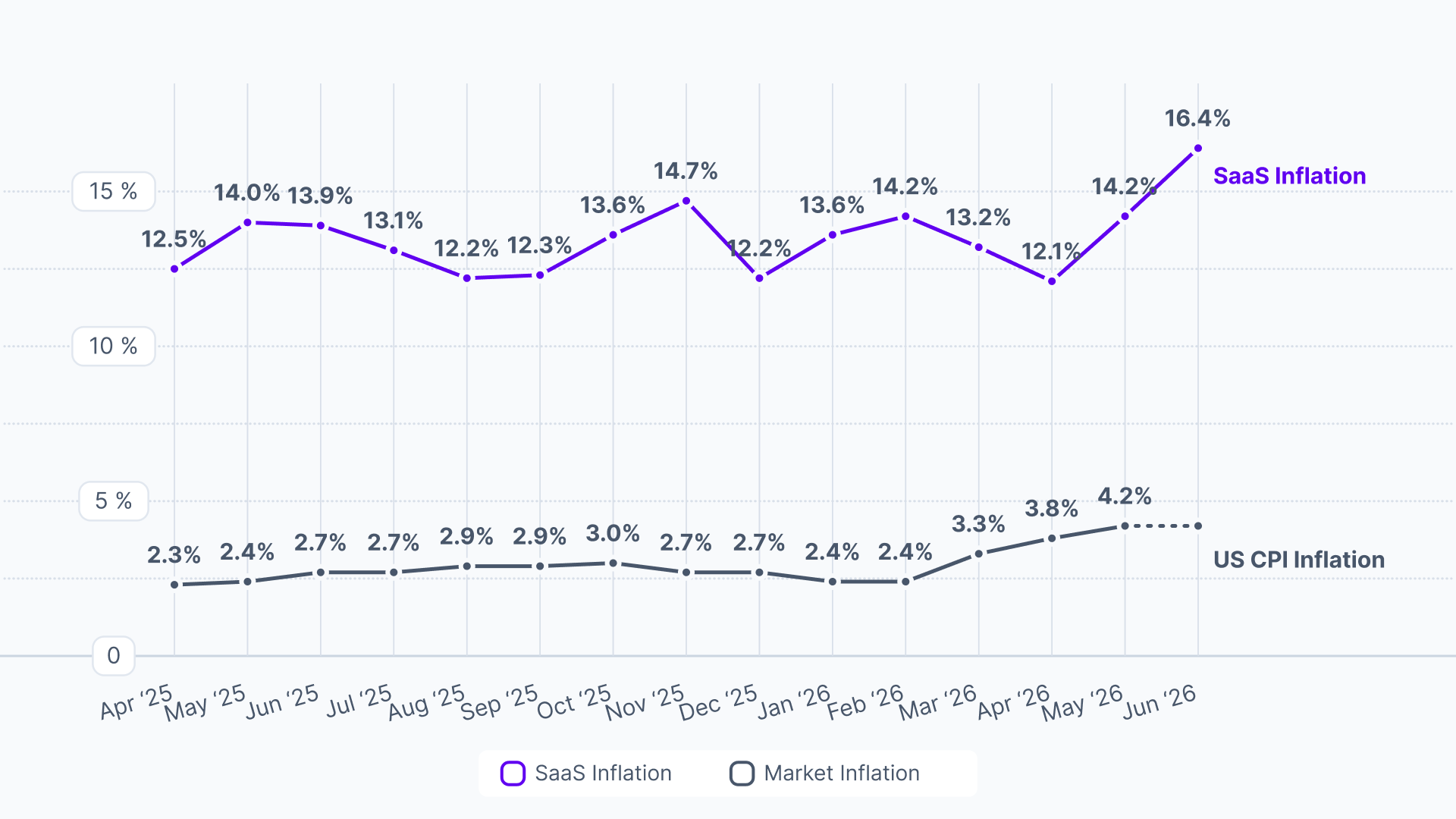
Software prices are climbing at close to four times the rate of everything else people buy. That has been going on for years now, and it accelerated alongside the AI feature wave.
So when a customer shows up to your pricing webinar in a bad mood, they aren't being irrational. They're carrying the aggregate of every renewal quote they have opened this year. You are getting the bill for your entire category.
 River Sloane
That's unfair to you personally but completely understandable from where they're sitting.
AI moved the reference point for what a feature costs
Here's the mechanism we think is actually driving the "more for less" feeling, and it is not entitlement.
For twenty years, users had no idea what software cost to build. Now a large number of them have watched something resembling their feature request get produced in a chat window in ninety seconds.
The demo was free. It looked finished. Their internal price for "add a filter to this table" collapsed.
What they have not seen is the other 95% of the work: the edge cases, the migration, the permissions model, the support load, the part where it has to be right every time and not just in the demo.
Developers know this gap intimately, and the data shows them losing patience with it.
Stack Overflow's 2025 Developer Survey had 33,662 people answer its AI questions. 84% percent are using or planning to use AI tools, up from 76% in 2024. But favorable sentiment fell to 60%, down from over 70% in both 2023 and 2024.
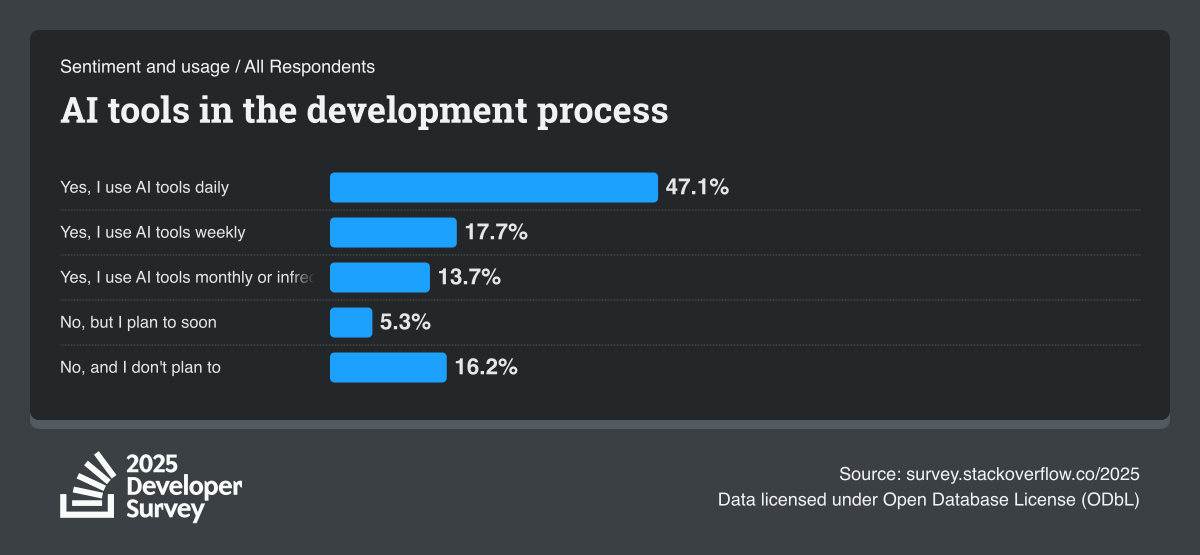
Only about a third trust the accuracy of what comes out. The single most cited frustration, at 66%, is AI output that is almost right but not quite.
That is the whole thing in one statistic. The demo is 90% of the way there, and the last 10% is where all the time goes. Your users have seen the 90%. They are pricing your work against it.
The same gap is showing up in support.
In the Qualtrics research I mentioned earlier, nearly 1 in 5 people said they got no benefit at all from AI in customer service, roughly four times the failure rate consumers reported for AI in other tasks.
AI customer service ranked near the bottom for usefulness, convenience and time saved. People were promised instant answers and got a bot that could not find the refund policy.
Saying the words "AI powered" can cost you
One more finding worth knowing before you write your next launch page.
Dogan Gursoy at Washington State University ran experiments with around 200 participants, published in the Journal of Hospitality Marketing & Management in 2024, covered here by Fortune.
Identical products were described either as "AI powered" or "high tech." Purchase intent dropped for the AI version, consistently, across every product category tested.
Small sample, consumer products rather than B2B software, so hold it loosely. But it lines up with the sentiment data, and it suggests the "now with AI" banner on a price increase may be doing the opposite of what you intended. You're pointing at the exact thing your customer suspects cost you nothing.
The backdrop: satisfaction has been flat since 2017
Zoom out and none of this is really about AI at all 😵
The American Customer Satisfaction Index runs about 200,000 customer interviews a year. Its national score for Q4 2025 was 76.9 out of 100, down half a percent year on year. More to the point, it has not materially moved since 2017.
"What AI did was lower switching costs, raise the volume of public complaint, and hand everyone a vivid mental image of how cheap your work looks."
ACSI's own read is that flat satisfaction alongside strong profits signals a long-term weakening in what buyers are actually getting. They describe the result as pent-up customer defection: people who are unhappy, held in place by switching costs, waiting for the friction to drop.
General AI didn't create that.
It's actually been building for the better part of a decade. What AI did was lower switching costs, raise the volume of public complaint, and hand everyone a vivid mental image of how cheap your work looks.
So are users more demanding?
No, not really. Yes, they're louder, more public, better armed with comparisons, and doing arithmetic on your pricing that they couldn't do before.
But the underlying demand hasn't multiplied. The channel changed and the reference price collapsed.
Which is oddly good news I suppose, because channel problems and expectation problems are both fixable, and "everyone became a monster in 2023" is not.
A few things follow from the data:
- Answer in public, because 43% of social complaints get met with silence and the ones that get a reply stop being a pile-on
- Show your working on price, since the person reading it has an entire category's increases in their head and no idea which part is yours
- Put the reasoning somewhere permanent instead of saying it once on a webinar, because a help center article outlives a chat window and gets found by the person who missed the announcement
- top treating a quiet queue as good news, given that 30% of unhappy people now tell nobody. Watch what they search for and fail to find instead.
The webinar chat was ugly. It was also, in its way, a gift. Those people showed up. Most of the others already left without saying anything.