AI Is a Brilliant Copyeditor and a Hopeless Editor-in-Chief
Editors were the first budget cut, and your docs know it. Why AI can catch the typos but can't do the one job that actually mattered.

Every night, I throw open my duvet, jump into bed, and adjust my pillow, and sink in for my half hour reading sesh. And whether I reach for my phone to scroll mindlessly or reach for my Kindle really depends on how engrossed I am in my book.
Some books I struggle to get through the first few pages. Others I simply can't put down.
The difference? The opener. And the opener largely depends on a great editor. Editors who know how to hook someone in, keep them drawn, and leave them hanging so they read the second chapter.
Don't get me wrong, nobody is engrossed in your help article. Sorry to break that to you.

Become an expert in all things Knowledge Base with our monthly newsletter. No spam, just expert content, delivered.
But it does matter. It matters because it's the difference between something going "Aha!" in the middle of cooking their stew vs. stewing over your terrible self-serve help article.
Budgets, budgets, budgets
Let's be real. Budgets are being cut, and the first ones to go are those who aren't "essential". And editors aren't deemed essential (and probably why articles aren't as interesting anymore).
And besides, most teams don't have the resources to also have a dedicated editor for a knowledge base, as much as we'd love that. So whether you're a technical writer or a support folk tasked with writing knowledge base articles, part of your job will be editing.
 River Sloane
You have to ensure you cut every word that's just going to confuse people, and hone into getting to the point but also providing enough context. And extra context if needed.
Whew, I mean, that's a lot for a person to carry. And that's just one help article. The problem is you know your product too well.
You wrote "just click the widget" because to you it genuinely is just a click, and to the person reading it at 11pm with a half-open support ticket, it is absolutely not.
An editor is really just the person who reads your work as a stranger would and tells you, kindly, that nobody understands this but you. Take that away and the quality doesn't collapse overnight. It slips, quietly, and you're the last person in the building to notice.
That's rather the point of quality slipping.
Use AI for a first pass edit
Which brings us to the obvious move. If a human editor is now a luxury, get the AI to do it.
And credit where it's due, AI is very good at a real chunk of the work. The four-line sentence that forgot where it was going. Passive voice you stopped noticing years ago. That one word you've used eleven times in a single article. Your own feature name capitalised three different ways on the same page.
 River Sloane
This is the tedious, mechanical consistency work humans hate and do badly.
AI never gets bored of it. It never gets precious (or so we hope). It reads your 400th article with the same attention it gave your first, which is more than any of us can honestly claim.
But a machine is a copyeditor, not an editor-in-chief
Here's the catch. AI does not know your product. It knows patterns.
So sometimes it'll suggest a change that's grammatically lovely and factually wrong, or just not your style. You'll naturally scoff at such a ridiculous suggestion.
It'll smooth over a warning you put there on purpose. It'll "simplify" a step that was complicated for a reason. It'll recommend a warmer, friendlier tone for your article about permanently deleting an account, which is not the moment for jazz hands.
The tricky part isn't that AI is occasionally wrong. It's that AI is wrong in complete, confident sentences. It never hedges. It never says "I think" or "maybe check this." The judgement a real editor brought, knowing which rule to break and when, is precisely the bit that didn't come in the box.
Bringing the editor back won't save you either
Before this turns into a eulogy, the honest part. Human editors weren't perfect, and neither are you.
We're precious about our own words. We'll defend a clever sentence long after it stopped being clear, purely because we're fond of it. We skim. We introduce our own inconsistencies and then genuinely cannot see them. We write "log in" on Monday and "login" on Tuesday and swear blind we did no such thing.
So the answer isn't nostalgia for the editor who got made redundant. It's the machine and the human working the same article, arguing productively, each catching what the other misses.
The style guide is the editor you get to keep
An editor carried the rules around in their head. What you call things, how long an article should run, British or American spelling, emoji or no emoji. When they left, all of that left with them, because nobody had written it down. Oops.
So write it down. Not just for you, your teammates, but also your AI.
A style guide is the closest thing to keeping the editor on staff. It's the one place your rules live and the one thing both your writers and your AI can point at when they disagree.
Without it, the AI optimises for generic best practice, your team optimises for whatever mood they're in, and your knowledge base ends up reading like it was written by a committee that never met even once.
We wrote a full guide on building one, from why it matters to what to put in it: Creating Calm & Consistency With a Knowledge Base Style Guide.
You're the editor now
That's the uncomfortable promotion. The old editor isn't coming back, so the job is yours, whether it's in your title or not.
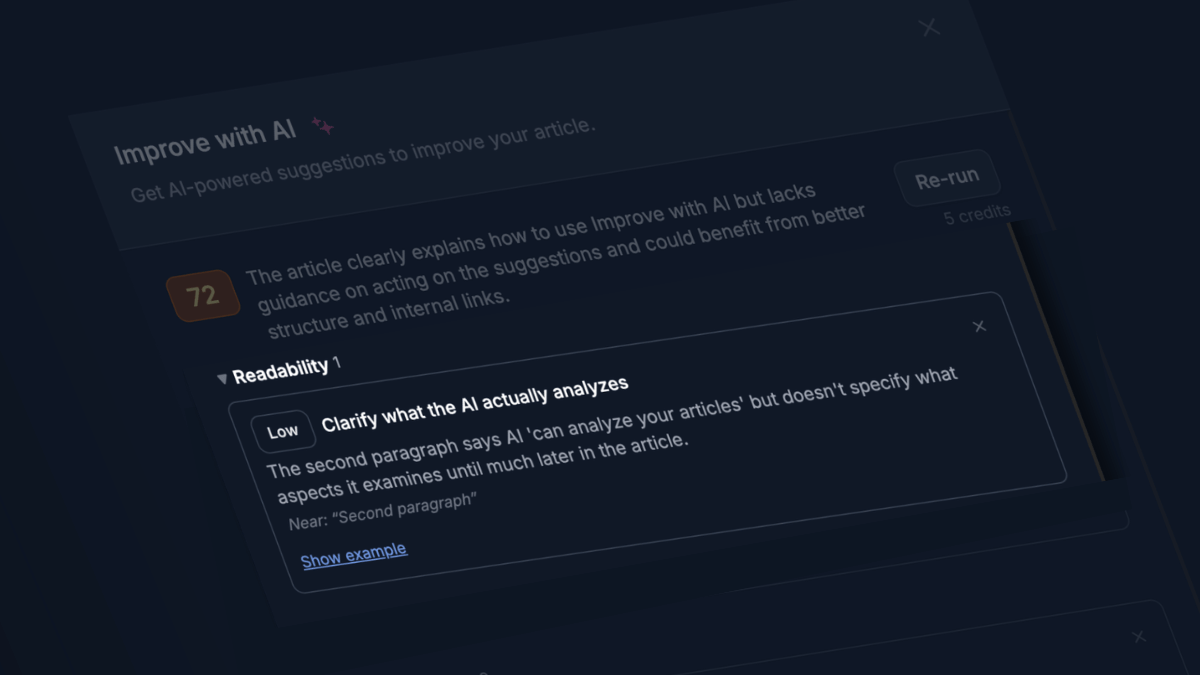
The good news is you don't have to do the tedious half on your own. Tools like Improve with AI will read an article and point at what's weak, so you get a second opinion without a second salary. It points. You decide.
Because AI has read more documentation than any human alive and still has no idea whether this particular change is right for this particular article, for this particular reader. You do. That was always the editor's real job. Now it's yours.